Eyewear is one of the few objects that can change how a person is read before they say a word. It sits at the center of the face, appears in every conversation, and follows its wearer from the first meeting of the day to the last table of the evening.
For years, that visibility was treated as a problem. Frames were designed to disappear. Contact lenses promised an unobstructed face. The safest glasses were often the ones that attracted the least attention. Fashion has reversed that logic. Eyewear is no longer something to hide. It has become something to choose deliberately.
Why are glasses becoming a status object now?
The shift has been visible across recent runway seasons. In its May 2025 survey of luxury eyewear, Vogue noted the prominence of optical frames at Miu Miu, Valentino, Thom Browne, and Gucci. Practical spectacles were being treated with the same attention normally reserved for watches, bags, and jewelry.
By 2026, that movement had become broader than a single runway moment. Vogue’s industry analysis described eyewear as a growing point of self-expression, while street-style coverage showed frames completing outfits rather than simply accompanying them.
The timing makes sense. Most wardrobes have become less formal and more interchangeable. A precise accessory can carry more of the look. When a shirt, jacket, and trousers are restrained, the frame becomes the signature.
What makes eyewear different from another accessory?
A bag can be set down. A watch can disappear under a sleeve. Glasses remain in view. Their scale may be small, but their position gives them unusual visual authority.
They also become familiar through repetition. The same frame can appear during a work call, on a train, at dinner, and in hundreds of photographs. Over time, it becomes less like an added detail and more like part of the wearer’s visual identity.
That familiarity is what gives eyewear status without requiring a large logo. Recognition can come from proportion, color, surface, and the relationship between the frame and the face. The strongest pair does not need to announce its value. It needs to look considered.
Do status frames have to be large or dramatic?
No. Fashion is currently moving in more than one direction. GQ’s January 2026 Paris street-style edit included round tortoise frames, slim metal shapes, and more visibly expressive silhouettes. Each worked because it clarified the wearer’s point of view.
The official MIDO 2026 trend report tells a similar story. It identifies both reduced, precise forms and reworked classics, with transparency, layered color, metal, and deeper natural tones all present.
There is no single correct volume. A quiet frame can signal taste through restraint. A heavier frame can do it through presence. Indifference is the only direction that does not work.
What does frame color communicate?
Color changes the character of a silhouette before it changes the outfit around it.
Matte Black gives the frame a defined outline. It works naturally with tailoring, denim, uniforms, and monochrome clothing. Black is direct. It makes the shape visible and gives a simple look structure.
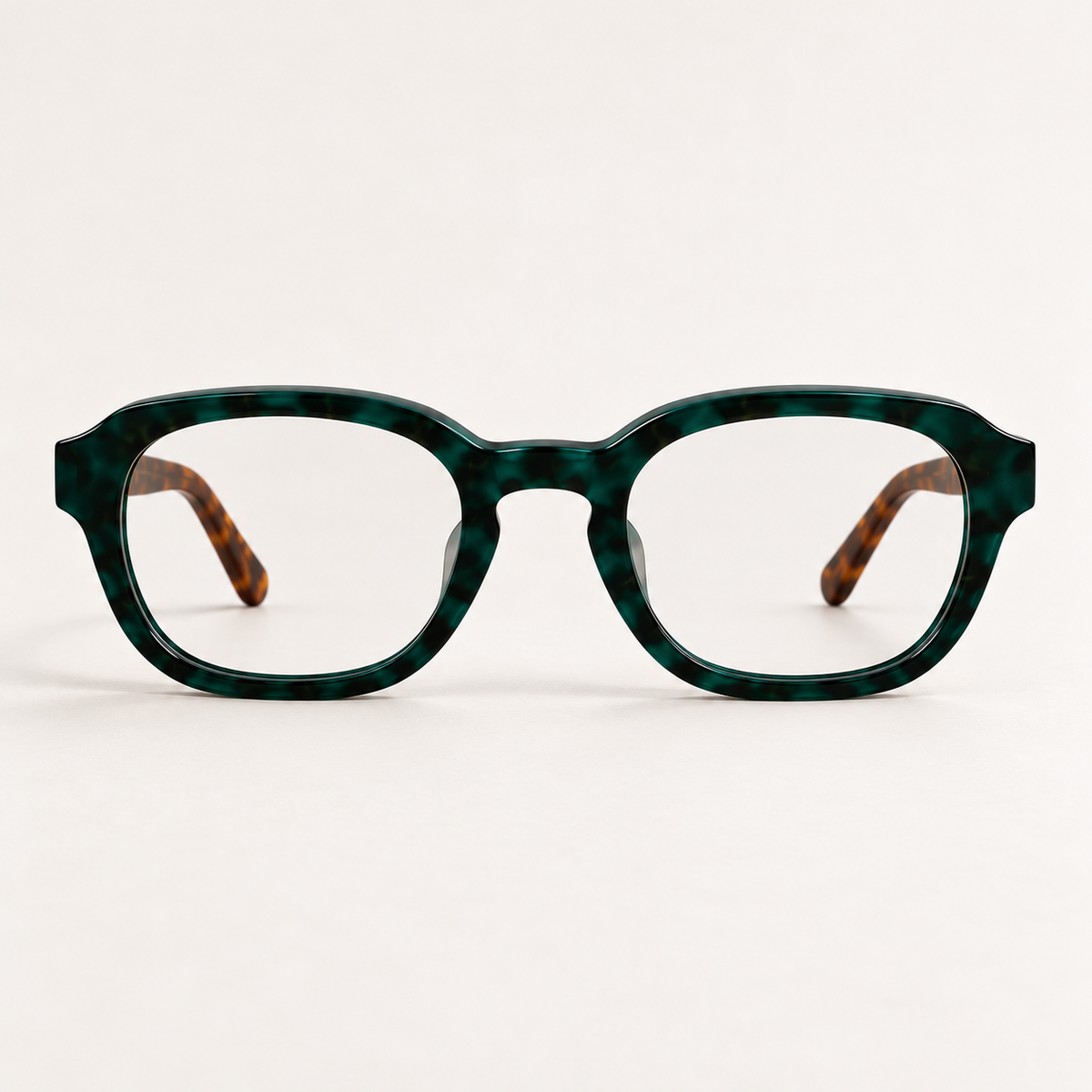
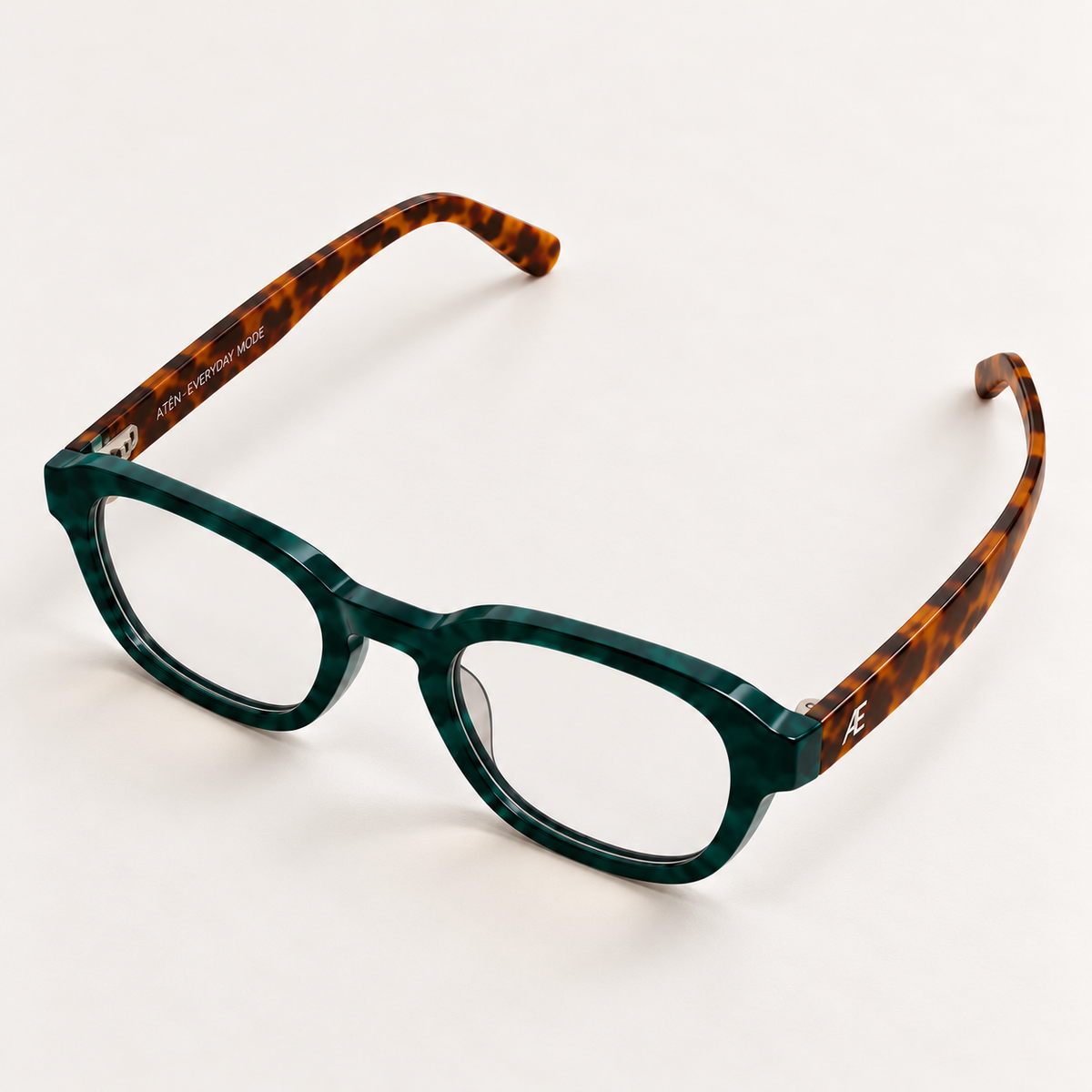
Forest/Tortoise introduces depth and variation. It belongs to the long tradition of tortoise eyewear without repeating the standard brown interpretation. The green shifts it slightly away from the expected, making it expressive without making it difficult to wear.
Crystal Clear takes the opposite approach. It allows more of the face to remain visible while keeping the frame’s geometry intact. Clear is not the absence of a decision. It is a decision to let light, skin tone, and the surrounding wardrobe change how the frame reads.
How should you choose when trends keep changing?
Eyewear trends move more slowly than clothing trends. The shapes that return each season—rectangles, ovals, aviators, cat-eyes, and rounds—are rarely new inventions. Their proportions and styling context change.
That makes personal repetition more useful than novelty. Ask which frame works with the clothes you already reach for. Consider whether you want your glasses to anchor a look, add texture, or recede slightly. Then imagine wearing them on an ordinary Tuesday, not only in a carefully styled photograph.
A frame earns its place through frequency. If it feels right with a coat, a T-shirt, a meeting, and an evening out, it has more lasting value than a shape chosen only because it appeared on a runway.
What does the eyewear shift mean for ATÉN?
It reinforces a simple position: the frame comes first. A functional lens does not excuse an anonymous object. Eyewear should still have proportion, character, and a reason for looking the way it does.
ATÉN approaches its eyewear as one silhouette expressed through three distinct colorways. The choice is not between fashion and function. It is between three ways of placing the same object within a wardrobe.
Eyewear became a status object when people stopped treating it as equipment to tolerate. The most convincing frames now do something quieter. They become part of how a person chooses to be seen.
For a closer comparison, read how to choose between the three frame colours, then explore the ATÉN collection.

Leave a comment
All comments are moderated before being published.
This site is protected by hCaptcha and the hCaptcha Privacy Policy and Terms of Service apply.