
Last reviewed October 2026.
An eight-hour screen day is not one problem with one solution. It is a sequence of small conditions: how bright the morning is, how close the display sits, whether you blink fully, where glare lands, and whether the room still looks like noon at ten at night.
Blue-light glasses can be one object in that environment. They are not a substitute for a better setup, an accurate prescription, an eye exam, or a break. The useful approach is to build the day first and choose the lens second.
What should happen before the first email?
Start with real daylight when you can. An international expert consensus on healthy light exposure recommends bright days and substantially dimmer evenings; its technical daytime target is at least 250 lux of melanopic equivalent daylight illuminance measured at the eye. You do not need a meter to understand the principle. A bright window and time outdoors usually create a clearer signal of day than a dim room lit only by a laptop.
Open the blinds. Take the first call near a window. Walk for coffee instead of asking the screen to be both your workplace and your source of morning light. The point is not to fear blue light all day. Blue-rich daylight is part of the natural daytime signal.
Why do eyes feel tired at a screen?
Digital eye discomfort is real. The best evidence does not make screen blue light the main cause. The American Academy of Ophthalmology points instead to the way we use devices: we blink less, hold focus at one distance for long periods, work too close, and tolerate glare or poor contrast for hours.
Build the desk around those causes:
- Distance. Keep the display roughly an arm's length away.
- Height. Set the screen so your gaze falls slightly downward rather than lifting your chin toward it.
- Brightness. Match the screen to the room. A white document should not look like a lightbox in a dark studio.
- Glare. Turn the desk or move the lamp before buying another accessory. Reflections force the visual system to work around competing contrast.
- Blinking. Finish the blink. Concentrated near work often turns a full blink into a partial one.
If symptoms persist, an eye-care professional can check dry eye, focusing problems and whether your prescription is right for your working distance. A frame cannot diagnose any of those.
Do breaks need to follow the 20-20-20 rule?
The 20-20-20 rule is memorable: every twenty minutes, look about twenty feet away for twenty seconds. Evidence for that exact formula is limited, but the underlying habit is sensible. Distance interrupts continuous near focus and a pause creates a chance to blink, move and reset the posture.
Use a rhythm you will actually keep. Finish a task, then look out the window. Take calls standing. Put water far enough from the desk that getting it requires leaving the screen. A perfect timer ignored all day is less useful than a natural break attached to work you already do.
Where does a lens fit?
Choose it by context, not by a promised outcome.
Everyday Mode has a subtle warm tint, the brightest view and the least colour shift for meetings, travel and mixed screen-to-room work. Focus Mode has a pronounced amber tint and is intended for tasks where precise colour is not critical. After Hours has a deep red tint, the darkest view and the strongest colour shift. It is not for driving.
None of those choices replaces breaks or desk design. Blue-filtering lenses have not consistently outperformed standard clear lenses for digital eye strain, including in a 2023 Cochrane review and a double-masked trial of 120 symptomatic computer users. ATÉN does not sell a treatment for screen discomfort. We make eyewear for people who want to manage their environment without being misled about what one object can do.
What should change after sunset?
The evening question is different from the eye-strain question. Light reaching the eye helps signal time of day, and that signal depends on brightness, spectrum, timing and duration. The room matters as much as the screen.
Three hours before the sleep period you are aiming for, begin reducing the total light load. Dim overhead lighting. Prefer lower, warmer lamps. Turn down display brightness as well as shifting the color temperature. A warmer screen at full intensity is still a bright screen.
If work has to continue, a strong evening lens can reduce part of the short-wavelength light reaching the eye. It should be treated as one layer in a darker room, not permission to keep every light on.
What does a practical workday look like?
| Moment | Condition to build | Lens consideration |
|---|---|---|
| Morning | Daylight, movement, a bright workspace | Do not block daylight by default |
| Focused work | Arm's-length screen, low glare, regular distance breaks | Everyday Mode or Focus Mode by task |
| Color-critical work | Calibrated display and stable room light | Remove amber or red tints |
| Evening | Lower, warmer and dimmer room light | After Hours only when appropriate; never for driving |
| Sleep environment | As dark as practical | Glasses come off |
What is the shortest version?
Bright days. A considered desk. Regular distance. Full blinks. Darker evenings. The frame belongs inside that system, not above it.
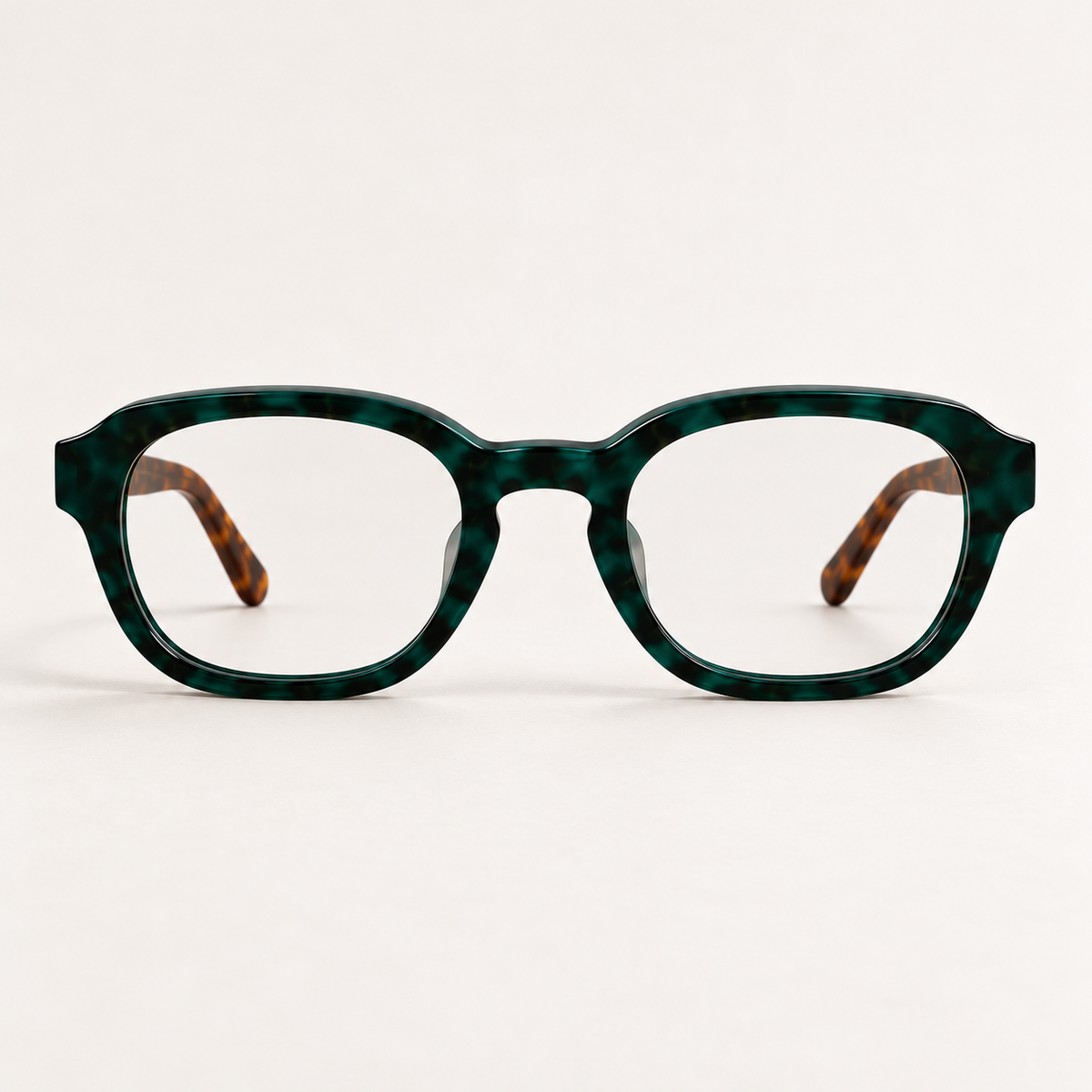
Read our evidence review, Do Blue Light Glasses Actually Work?, or explore the Matte Black frame.
Sources
American Academy of Ophthalmology. Digital Devices and Your Eyes.
Brown TM, Brainard GC, Cajochen C, et al. Recommendations for daytime, evening, and nighttime indoor light exposure.
Singh S, Downie LE, Anderson AJ, et al. Blue-light filtering spectacle lenses. Cochrane Database of Systematic Reviews, 2023.
Singh S, Downie LE, Anderson AJ. Do Blue-blocking Lenses Reduce Eye Strain From Extended Screen Time? American Journal of Ophthalmology, 2021.
Explore ATÉN
Build the routine first, then compare Everyday Mode, Focus Mode and After Hours in the ATÉN lens guide and ATÉN collection.

Leave a comment
All comments are moderated before being published.
This site is protected by hCaptcha and the hCaptcha Privacy Policy and Terms of Service apply.