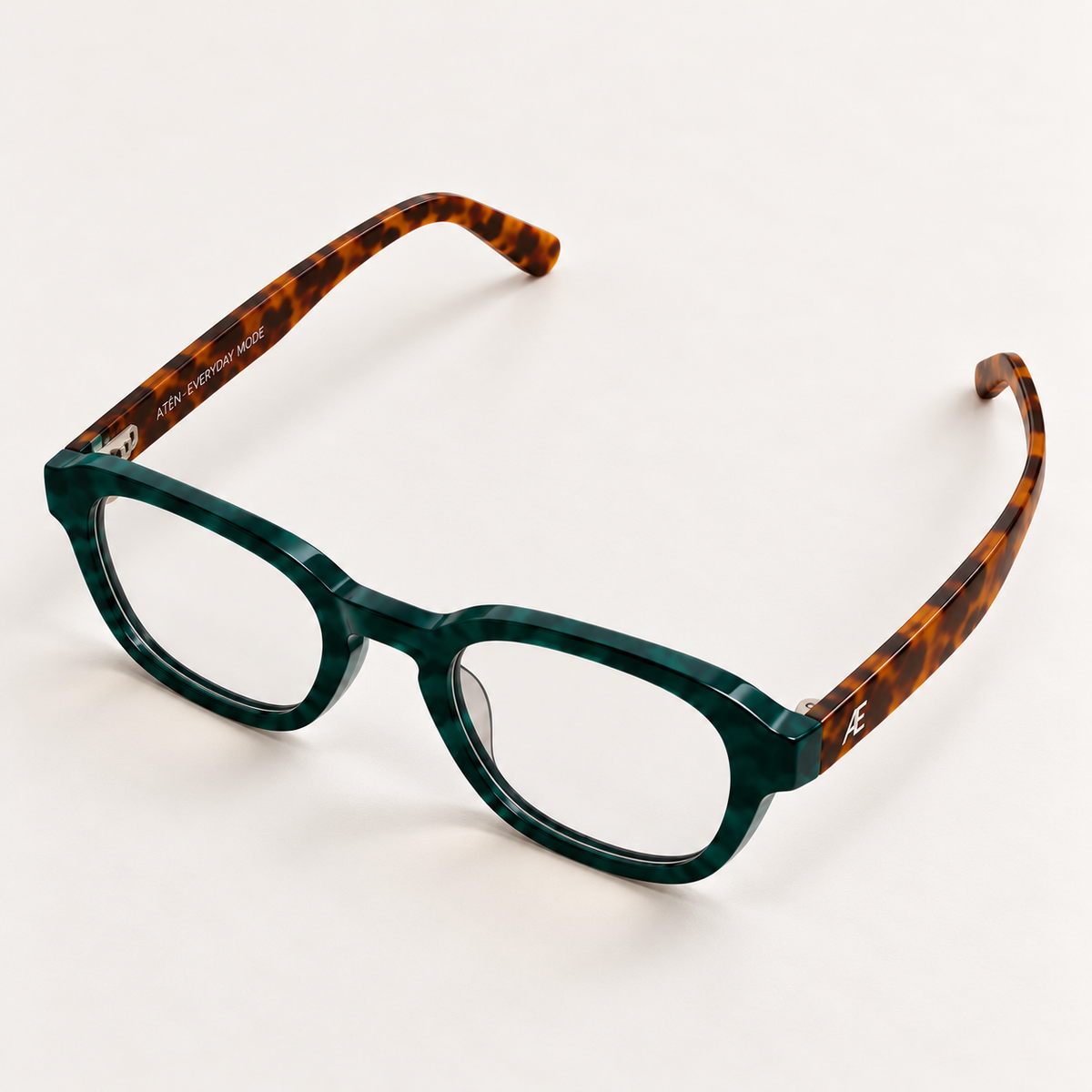
ATÉN begins with one silhouette. Not because one frame can suit every person. It cannot. We begin with one because a clear point of view is more useful than a wall of near-duplicates.
This is restraint as a design method: fewer variables, examined more closely.
Why begin with one frame?
More choice can look like progress. In eyewear, it can also conceal indecision. A collection may contain dozens of shapes that differ by a few millimeters, a slightly altered corner, or another name. The quantity is visible. The reasoning is harder to find.
ATÉN starts elsewhere. One silhouette creates a fixed design question: can proportion, line, color, and lens work together well enough to deserve repetition?
That question is demanding. There is no secondary frame to distract from an unresolved decision. The silhouette has to carry the identity of the collection, whether the lens has a subtle warm, pronounced amber or deep red tint.
The result is not a claim that one frame is objectively correct. It is an admission that design becomes clearer when a brand is willing to choose.
What does one silhouette allow us to examine?
A limited system creates room for attention. Instead of distributing effort across a broad catalog, it keeps returning to the relationships that determine how eyewear actually looks and feels.
| Element | Question it forces us to ask |
|---|---|
| Proportion | Does the frame feel deliberate from the front, side, and three-quarter view? |
| Color | Does the frame treatment change the character of the same underlying form? |
| Lens | Does each tint belong to the frame rather than looking added afterward? |
| Communication | Can we explain why each option exists without inventing a new story for it? |
These are small questions with visible consequences. A familiar outline can become severe, quiet, or expressive depending on the treatment around it. The silhouette provides continuity. The remaining choices supply variation.
Does one silhouette fit everyone?
No. Faces differ in width, bridge shape, proportion, and preference. A single frame cannot responsibly be described as universal.
The answer is not to blur that limitation with words such as “perfect fit.” It is to provide useful fit information, clear measurements, and honest on-face photography so a customer can make a considered decision. Style advice can help. It cannot remove anatomy or personal taste from the equation.
Beginning with one silhouette therefore asks more of ATÉN’s product presentation. The frame should be shown from useful angles and on more than one face. Its scale should be understandable before purchase. Where the shape is unlikely to work, the brand should not imply otherwise.
Restraint is credible only when its limits are visible.
How can one frame create distinct expressions?
The ATÉN system combines three frame treatments with three lens modes.
- Matte Black is sharp and structured.
- Forest/Tortoise gives the silhouette its most expressive treatment.
- Crystal Clear is clean and precise.
Each is available with Everyday Mode in a subtle warm tint, Focus Mode in pronounced amber, or After Hours in deep red. The frame remains consistent; the visual temperature and intended context change.
This creates meaningful variation without pretending every combination is a new invention. Everyday Mode is the quietest expression. Focus Mode makes the lens more visible. After Hours is the strongest tint and is intended for the final 2–3 hours before your usual bedtime, not driving.
Together, the options form a small system rather than a sequence of disconnected products.
Why put eyewear before the blue-light story?
Because the object still has to earn its place when the claims are removed.
Blue-light eyewear is often presented as a list of promised outcomes. That approach can reduce a frame to a delivery mechanism for percentages, diagrams, and wellness language. ATÉN begins with the opposite test: would this still be considered eyewear if nobody mentioned a screen?
The lens system matters. So do the frame’s line, color, and relationship to the wearer’s clothes. Function does not excuse an unresolved object, and fashion does not justify an unsupported health promise.
The two can coexist when each stays in its proper role. The frame supplies design. The lens supplies a defined visual filter and use context. Neither requires a claim that wearing it will improve concentration, relieve eye strain, or change sleep.
Does a single silhouette mean ATÉN will never change?
No. One silhouette is a starting standard, not a permanent ceiling.
Good systems can grow without discarding their original logic. Outside eyewear, the Vitsœ 606 system is a useful example: its value comes from continuity and the ability to extend a coherent idea rather than replace it with every cycle.
Within eyewear, the Cubitts Journal regularly treats frame design, making, and cultural context as subjects worth examining in their own right. That editorial approach is a reminder that a silhouette can carry thought, not only trend.
If ATÉN introduces another shape, it should solve a real limitation or express a genuinely different proportion. It should not exist only because a larger catalog looks more established.
What standard does one silhouette set?
It sets a test for every future decision.
Does the addition make the system clearer? Does it serve a person the first frame could not? Does it introduce a proportion with its own reason for being? Can it be explained without inflated language?
If the answer is no, more is simply more.
ATÉN makes one silhouette because focus begins with exclusion. The things left out give shape to the thing that remains.
See the intended context for each tint in the ATÉN lens guide, compare the three treatments in the frame-colour guide, and explore the full ATÉN collection.


Leave a comment
All comments are moderated before being published.
This site is protected by hCaptcha and the hCaptcha Privacy Policy and Terms of Service apply.